
A cracked balcony doesn’t make headlines in architectural dramas. Yet, ignoring such a problem opens the door to much more serious disorders. Concrete, this material said to be unshakeable, has its flaws: humidity, temperature variations, poor workmanship, or simply aging. Cracks, even subtle ones, require targeted and prompt treatment. Depending on their origin and the configuration of the support, solutions vary. A poor choice of technique, or a hasty preparation, especially during the application of the cement slurry, can render the repair useless and, in the long run, expose one to more costly damages.
Identifying and Understanding Cracks on a Concrete Balcony: Signs That Should Raise Alarm
Over the years, concrete balconies are not immune to the appearance of cracks. Their shape, location, orientation: every detail matters to understand what is happening beneath the surface. We encounter longitudinal cracks (related to thermal expansion or uneven load distribution), horizontal cracks (resulting from concrete shrinkage or internal tensions), and vertical cracks (indicating a lack of reinforcements or a defect in the design of expansion joints). As for microcracks, they may seem harmless but often betray the beginning of a weakening.
Less than 3 mm wide? We’re dealing with something superficial. But as soon as the crack enlarges, the stability of the slab may be at stake. Other signs should also draw attention: rapid appearance of new cracks, traces of humidity, stagnant water near sensitive points. Because when water infiltrates, the corrosion of internal steels accelerates and the concrete deteriorates, especially during freezing spells.
Inspecting a balcony means meticulously tracking down every anomaly. One should not neglect the edges of joints, drainage areas, or the underside of the slab. Overloaded or poorly drained balconies are more exposed. To go further and find tips for renovating a concrete balcony, the article ‘Repairing a Crack on a Balcony: Steps for a Durable Result’ offers a detailed analysis.
The nature of the crack provides information about the problem, its likely evolution, and the risk of worsening. It is the precise diagnosis that guides towards the appropriate solution, allowing for the prevention of recurrent infiltrations or more serious structural damage.
Which Products and Techniques to Choose for Effective Repairs Depending on the Type of Crack and Humidity?
Before bringing out tools and materials, one rule: prepare the surface meticulously. Dust removal, brushing, elimination of foreign bodies, nothing is left to chance. It is this rigor that determines the success of a repair on concrete.
Here are the solutions suited to each scenario:
- For microcracks (less than 3 mm), simple re-pointing is sufficient. We rely on a flexible sealant or a finely formulated mortar, capable of accommodating the movements of the concrete and blocking humidity.
- For wider cracks, filling is done with a fiber-reinforced repair mortar. Applied with a trowel and then carefully smoothed, it ensures a uniform and durable surface.
- In the case of structural cracks (those that compromise the stability of the balcony), resorting to epoxy resin injection is essential. This technique, generally reserved for professionals, restores the unity of the concrete and isolates the weakened reinforcements. For areas subjected to heavy loads, polyurethane offers appreciated elasticity and water resistance.
To enhance protection, it is wise to apply a water-repellent treatment over the entire slab. This preventive treatment avoids long-term infiltrations and limits the frequency of repairs. The choice of product will depend on the level of water exposure and the porosity of the support. The application itself must adapt to the configuration of your balcony to ensure lasting and reliable protection.
Essential Precautions and Mistakes to Avoid for Durable Repairs with Cement Slurry
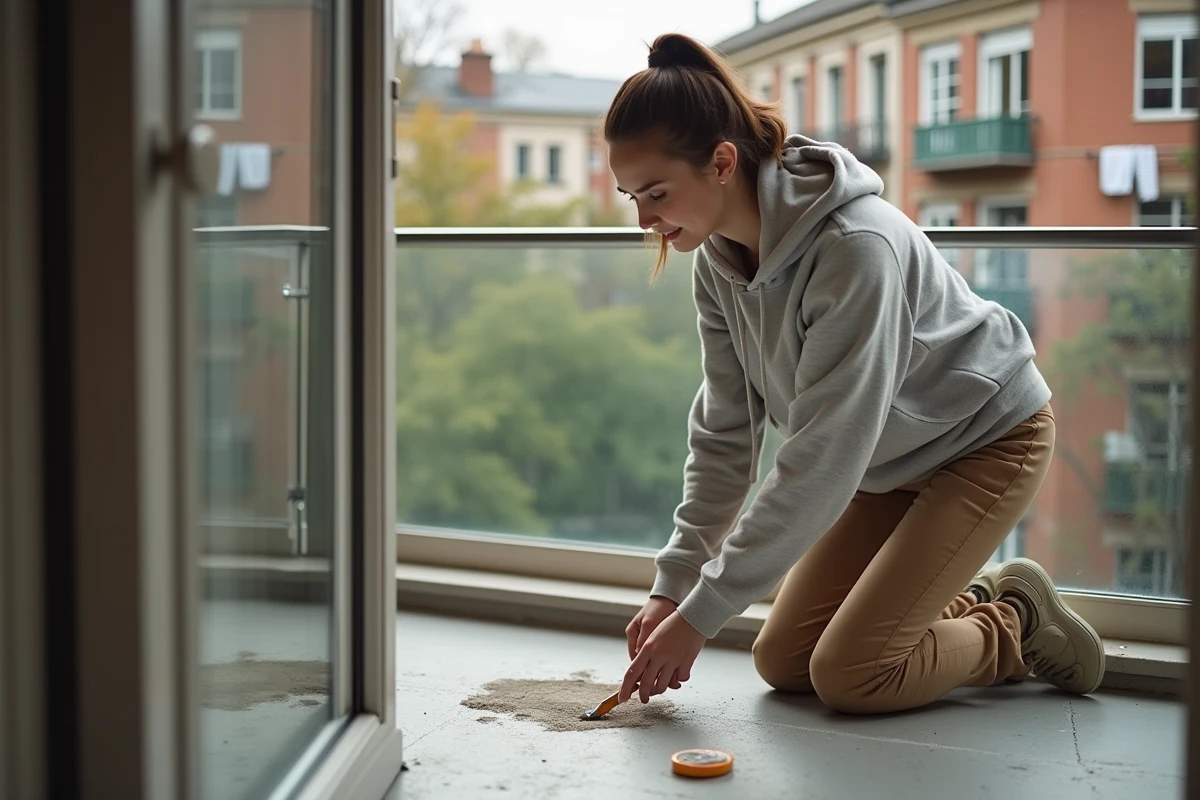
Repairing a crack on a concrete balcony is not something to be improvised. It all starts with meticulous surface preparation. At the slightest trace of dust or dirt, adhesion is compromised. Wire brushing, vacuuming, thorough drying: every step counts. If the crack is damp, it must be dried quickly; the slurry won’t hold on a wet surface.
The cement slurry must be applied on a sound, clean, and slightly damp base. Excess water dilutes the setting and weakens the repair. Respect the dosages, work until achieving a homogeneous texture. Apply in thin layers, press to remove air, and smooth without delay. If too thick, the product risks shrinking and cracking again; if too thin, it loses waterproofing and strength.
Among the common mistakes: neglecting regular balcony maintenance. Monitor the joints, check the slope for proper water drainage, and stay attentive to the slightest emerging microcrack. Finishing with a water-repellent treatment helps guard against freeze/thaw cycles, discreet yet formidable scourges for the concrete slab. Rigor and follow-up: that’s the best assurance for a durable repair and a balcony that withstands the seasons without faltering.