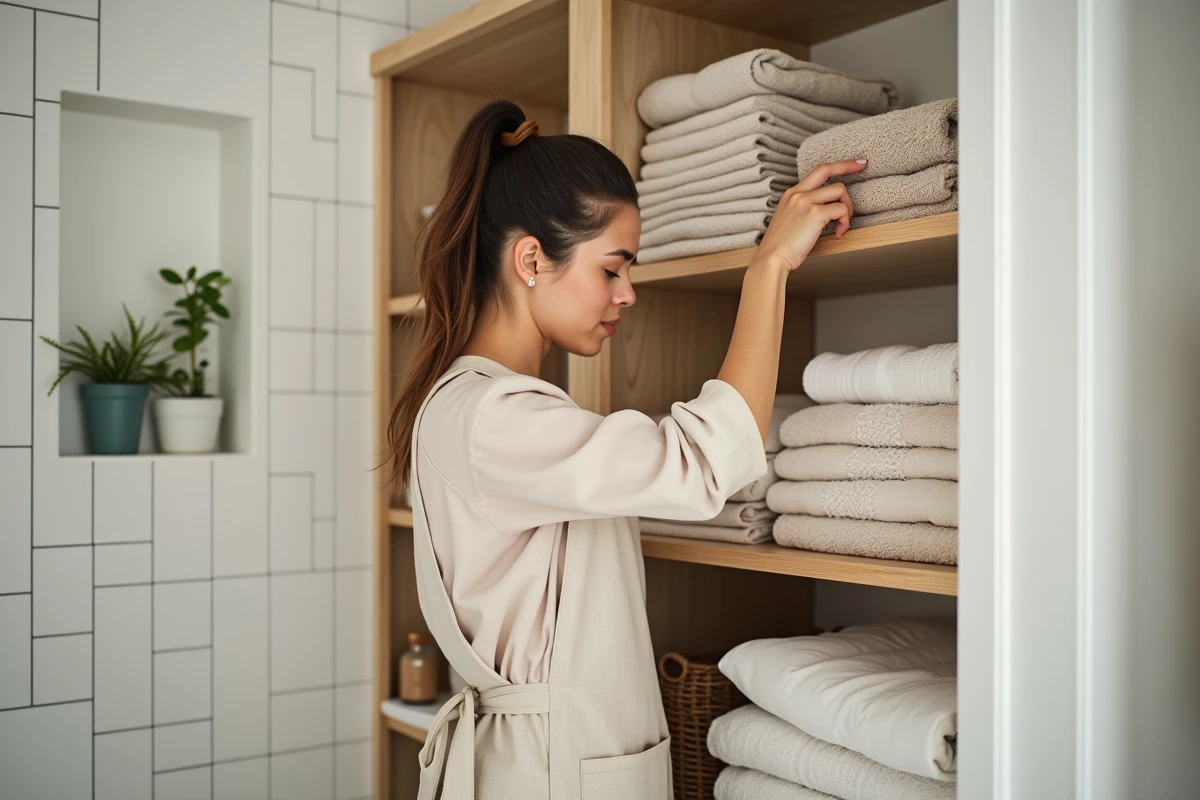
Organizing and maintaining your home on a daily basis relies less on motivation than on the mechanics of habits. Most French households spend several hours a week on cleaning and tidying up, often without a defined method. The result: a diffuse mental load, accumulating tasks, and a constant feeling of being behind. Understanding what really works requires distinguishing high-impact routines from cosmetic gestures that give the illusion of order.
Micro-tasks and mental load: what daily tidying hides
The two-minute rule, popularized by the GTD method, is echoed everywhere: if a task takes less than two minutes, you should do it immediately. The principle seems logical. In practice, it generates a constant flow of small interruptions that fragment attention.
The problem is not the task itself, but the decision it imposes. Every misplaced item, every surface to wipe, every piece of clothing to fold requires a judgment call. And these judgments, accumulated over a day, produce a cognitive fatigue that goes unnoticed.
To reduce this load, the most reliable approach is to eliminate decisions rather than accelerate them. Assigning a fixed place for each category of item, standardizing the cleaning products used, defining a unique time slot for household chores: these choices, made once, eliminate dozens of micro-decisions each day.
A practical guide on Ma Maison Info details this type of method room by room, based on the principle that sustainable organization comes from the system, not from individual effort.
Home maintenance: actual frequency according to surfaces
Cleaning advice often sets arbitrary frequencies: vacuum every day, clean the bathroom every week, wash the windows every month. These benchmarks ignore a determining variable: the type of surface and its exposure.
Floors and textile coverings
A varnished parquet floor in an entryway does not get dirty at the same rate as kitchen tiles. The fibers of a carpet hold dust and allergens much longer than a smooth floor. Adapting the vacuuming frequency to the traffic of each room avoids both under-maintenance and unnecessary cleaning.
High-traffic areas (entryway, kitchen, living room) deserve frequent vacuuming. Adult bedrooms, less used during the day, can follow a more spaced-out rhythm without compromising hygiene.
Kitchen and bathroom: the critical areas
The sink, countertop, and stovetop concentrate the majority of food stains. Cleaning these surfaces after each use with an appropriate product (a mixture of water and white vinegar is sufficient for daily use) prevents limescale and grease from building up.
The bathroom presents a different problem. Humidity promotes mold, especially in tile joints and around faucets. Ventilating the room after each shower remains the most effective gesture to limit this phenomenon, even more so than regular chemical cleaning.
Household products: what really helps in daily life
The proliferation of specialized products (a spray for each surface, a detergent for each room) complicates storage and increases the budget. Field feedback varies on this point, but several minimalist approaches converge on one conclusion: three to four basic products cover almost all everyday maintenance needs.
- White vinegar, effective against limescale and streaks on glass, usable diluted in water on most smooth surfaces
- Baking soda, slightly abrasive, suitable for cleaning sinks, stovetops, and tarnished joints
- Black soap, a versatile degreaser for floors, wooden furniture, and even some textiles
- A concentrated dish soap, which works for both dishwashing and occasional cleaning of greasy surfaces
This base reduces the number of bottles under the sink, simplifies shopping, and limits exposure to irritating compounds found in some industrial products. Fewer, better-chosen products cover more tasks than a cabinet filled with specialized sprays.
Tidying and decluttering: the only method that lasts over time
Sorting your belongings once or twice a year only produces lasting results if the volume of incoming items is controlled. Occasional decluttering, as satisfying as it may be, does not compensate for a constant flow of purchases or received donations.
The most robust principle remains that of controlled flow: every item that enters the house replaces an item that leaves. This mechanism prevents the gradual saturation of closets and makes tidying easier, as the total volume remains stable.
Tidying by zone rather than by category
Organizing room by room, treating each zone as a self-contained system, yields better results than a global sort by category of item (all books, then all clothes, then all papers). The reason is practical: a completed zone provides an immediate visible result, which maintains motivation.
For each room, three questions are sufficient to make decisions:
- Has this item been used in the last six months?
- Does it have a defined place in this room?
- Is it duplicated or triplicated in the household?
Items that fail all three criteria can be given away, sold, or recycled without regret. Storage furniture should be chosen based on actual content rather than available space: an oversized closet invites accumulation, while a properly sized piece imposes natural discipline.
Maintaining and organizing a home is not about occasional effort but about the repetition of simple actions, calibrated to the real constraints of each room. A system that operates with few products, adapted frequencies, and a stable volume of items requires less time than a constant race to tidy up.